
Invariant-manifold-based trajectory to intercept 2029 Apophis flyby
Project name:
Invariant-manifold-based trajectory to intercept 2029 Apophis flyby
Client name:
KTH – Thesis project
Student name:
Lucas Barbero Sanchez
Duration:
2025
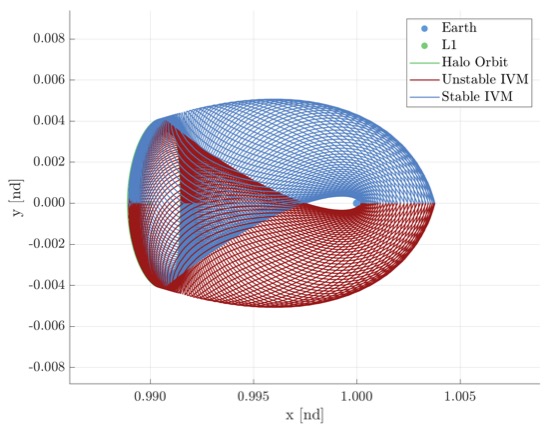
On April 13th, 2029, asteroid (99942) Apophis will pass within 31 600 km of Earth’s surface, o\ering a unique opportunity for plasma physics observations as it moves through the magnetosphere and interacts with the outer radiation belt, ring current, and edges of the plasmasphere. This thesis project explores a low-thrust trajectory strategy for a small 12U CubeSat platform named Onuris to intercept Apophis during its close flyby. The asteroid’s retrograde motion with respect to Earth, its high relative velocity, and the narrow interception window make this a challenging mission. To address these challenges, a trajectory framework is developed based on periodic orbits and their associated Invariant Manifold (IVM) in the Circular Restricted Three Body Problem (CR3BP). A Phase-Space Informed (PSI) design strategy is introduced, with transfer arcs originating from periodic solutions around the Sun–Earth Lagrange points. A Lunar Gravity Assist (LGA) maneuver is also considered to patch realistic launch opportunities with computed PSI strategy profiles. The resulting trajectories
demonstrate flexibility in timing and feasibility under tight mission constraints, contributing not only to the design of a potential flyby mission to Apophis, but also to broader applications in planetary defense, such as rapid-response asteroid interception.